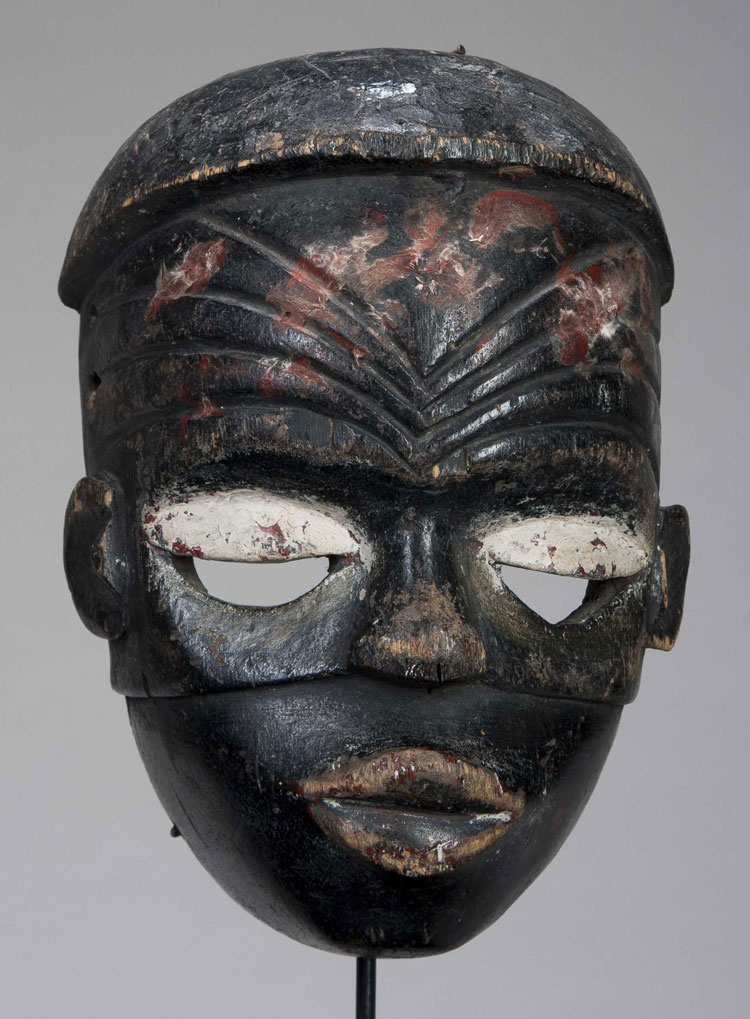
There is a particular kind of silence that happens when a serious collector is asked to evaluate a mask.
They pause. They turn the object slowly in their hands. They point out the tool marks, the aging pattern on the back, the weight distribution that only makes sense if the piece was actually worn. And then almost apologetically they say something like: “Well, I’m not really an expert. I just know what I’ve seen.”
That sentence is worth examining. Because what they are describing, without realizing it, is expertise.
The Paradox of the Informed Collector
The longer someone collects masks seriously, the more they tend to discount what they know. This is not false modesty. It comes from something real: the more deeply you understand a tradition, the more you become aware of how much remains uncertain. You know that regional attribution is contested. You know that carbon dating is expensive and imprecise. You know that dealers sometimes disagree. And so you hedge.
Meanwhile, the person who bought three Balinese masks last year at a resort speaks with total confidence.
This is a familiar dynamic in many fields a version of what psychologists call the Dunning-Kruger effect in reverse. But in collecting, it has a practical consequence that goes beyond ego: the collector who underestimates their experience often defers to the wrong voices at the moment of purchase.
What “Experience” Actually Means in This Context
When we talk about experience in mask collecting, we are not talking about formal credentials. There is no certification for this. We are talking about something more tactile and cumulative: the thousands of small comparisons that happen in the mind of someone who has handled a lot of objects.
You have learned what old wood smells like versus wood that has been artificially aged. You have noticed that the paint on genuine dance masks tends to crack in specific ways depending on how they were stored and that reproductions crack differently, or not at all. You have held pieces in your hands that felt wrong before you could say why, and later figured out what the wrongness was.
None of this fits neatly into a sentence. It is embodied knowledge the kind that accumulates slowly and cannot be transferred by reading an article. And it is precisely because it cannot be easily articulated that collectors tend to distrust it.
The Auction Room and the Hesitation
Consider what happens in an auction setting, or even in a direct transaction between a seller and a serious buyer.
The seller, who may have far less experience, speaks with the authority of ownership and narrative. They have a story about where the mask came from, who made it, what ceremony it was used in. The buyer who may know, at some level, that the proportions are slightly off, or that the patina does not match the claimed age hesitates to contradict. They worry they are missing something. They defer to the story.
This is how experienced collectors end up buying things that their own eyes told them not to buy.
The story is seductive precisely because it fills the gap that experience refuses to fill. Experience says I’m not sure. The story says I know exactly. And in the moment of purchase, certainty is easier to hold onto than doubt.
The Trouble with Delegating Judgment
There is a deeper issue here, and it has to do with what happens when collectors stop trusting their own eyes and start looking for external validation.
The appeal to authority the certificate of authenticity, the provenance document, the dealer’s reputation is not worthless. These things matter. But they are also gameable in ways that your own accumulated experience is not. Documents can be forged. Provenances can be fabricated. Reputations can be borrowed or misrepresented.
What cannot be easily faked is the slow accumulation of comparative knowledge in your own hands. The collector who has held fifty Kifwebe masks knows something that no document can replicate: what the object is supposed to feel like.
This is not to say that documentation is irrelevant, or that gut feeling is always right. The point is more subtle: external validation is most useful when it confirms what your experience is already telling you and most dangerous when it is used to override what your experience is already questioning.
If you are a serious collector someone who has spent years building knowledge through handling, reading, traveling, and looking ask yourself honestly: when was the last time you walked away from a purchase because something felt wrong, even though you couldn’t fully articulate why?
And when was the last time you bought something despite that feeling, because someone else’s confidence or documentation seemed to outweigh your hesitation?
The answer to those two questions tells you something important about whose judgment you are actually